REVIEW · DUBROVNIK
Dubrovnik Old Town History Walking Tour
Book on Viator →Operated by Dubrovnik Walking Tours · Bookable on Viator
History walks better than maps. This 1.5-hour Dubrovnik Old Town history tour strings together the city’s biggest landmarks with a local guide’s stories, starting at Onofrio’s Large Fountain by the Hard Rock Cafe and red umbrella. I like that the guides can feel genuinely local, with names like Ermina, Ivana, and Jelena popping up in the standout experiences.
I also love the way the walk gives you fast context, not just photo stops—Ragusa’s rise as a maritime trading city-state, the role of religion in the street-by-street layout, and what Dubrovnik went through in the Yugoslavia era and the 1990s. A possible drawback: Dubrovnik Old Town is built for walking, and this route takes you through steps, narrow lanes, and busy areas, which can be tough if you have mobility limits or prefer quieter streets.
In This Review
- Key things I’d prioritize on this walk
- Meet at Onofrio’s Fountain and Get Oriented Fast
- Ragusa Origins: Aqueducts, Religion, and the Street You’ll Use All Trip
- Franciscan Church and Monastery: The Library and Pharmacy Details
- Stradun (Placa): Where Ceremonies Happen and History Gets Complicated
- Holy Annunciation and the Mix of Faiths in the Side Streets
- Gundulic Square Market Energy and Ivan Gundulic’s Monument
- Rector’s Palace and Cathedral Legends: The Power Center Meets the Myth
- City Harbor: Ships, Quarantine, and Fortresses You Can Actually Find
- Orlando Column, Luza Square, and Finishing Under the Bell Tower
- Price, timing, and why this costs about $24.19 well spent
- Practical tips before you go (so you enjoy the walk more)
- Should you book Dubrovnik’s Old Town History Walking Tour?
- FAQ
- How long is the Dubrovnik Old Town History Walking Tour?
- Where do we meet for the tour?
- Is the tour offered in English?
- What’s included in the price?
- Do I need to pay admission for the stops?
- What if the weather is poor?
Key things I’d prioritize on this walk
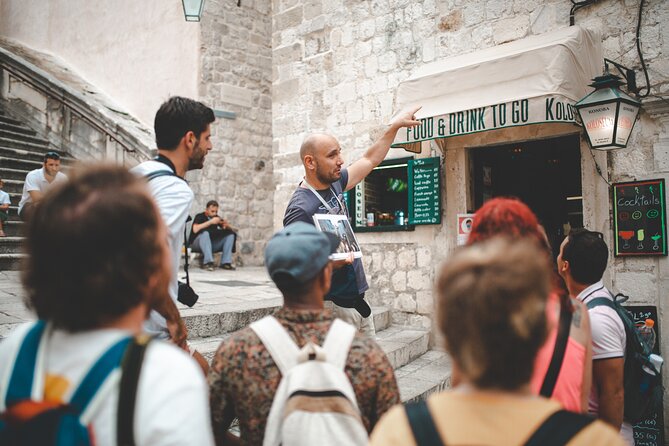
- Onofrio’s Fountain as a smart starting point with a quick history primer before you even move
- Stradun (Placa) and the city’s split in two so you understand where everything sits
- Franciscan Church and Monastery details that are easy to miss alone like the old library and pharmacy
- Harbor storytelling that connects ships, quarantine, and fortresses
- Rector’s Palace to Cathedral to Luza Square in one sweep so the power centers make sense
- Small-group feel (max 30) with an easy pace for a 90-minute overview
Meet at Onofrio’s Fountain and Get Oriented Fast
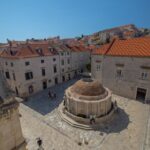
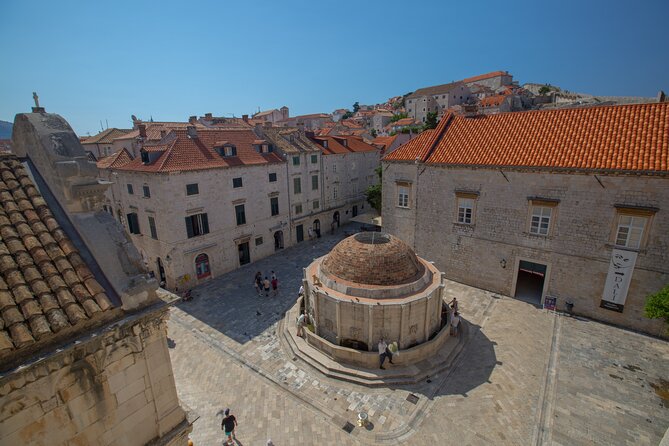
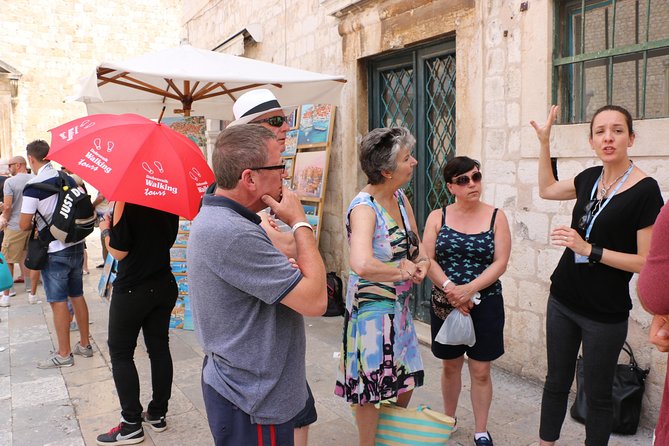
You start at Large Onofrio’s Fountain (Poljana Paska Miličevića 2000), right by the Hard Rock Cafe and the red umbrella. It’s a great move because it anchors you in the Old Town’s geography before you go hunting for landmarks on your own.
The tour runs about 1 hour 30 minutes, in English, and you’ll likely be in a group of up to 30 people. That matters because Dubrovnik can feel like one long postcard. This route gives you a way to understand what you’re seeing while you’re still fresh.
Guides often add personal touches. In past tours, people have specifically praised local guides such as Ermina, Ivana, and Jelena for turning history into something you can picture. If you like asking questions and getting straight answers (not just dates), this style tends to fit well.
You can also read our reviews of more walking tours in Dubrovnik

Ragusa Origins: Aqueducts, Religion, and the Street You’ll Use All Trip

Right at the fountain, your guide sets the baseline: Dubrovnik’s earlier identity as Ragusa, a small but powerful maritime trading city-state. You’ll hear about its achievements, including the aqueduct system that the Large Onofrio’s fountain is tied to. It’s a neat reminder that the beauty in front of you also has engineering behind it.
From there, you walk down the main street and pass by the small votive Church of the Holy Savior. It’s easy to overlook, but the guide uses it to talk about religion’s role in shaping the city’s feel and institutions. That kind of framing is exactly what helps later when you’re choosing which church to pop into and why.
This section is short—think quick stops, not a long lecture—but the payoff is big. You start to see Dubrovnik’s Old Town as a system: water, faith, trade, and defense all connected through the layout.
Franciscan Church and Monastery: The Library and Pharmacy Details
One of the best parts of this walk is the Franciscan Church and Monastery stop. The complex is a big one: monastery, church, library, and pharmacy, tied to the Order of Friars Minor. The tour gives you dates and details that make it feel real, not like trivia.
You’ll learn that the earliest monastery dates to the 13th century, originally built outside the walls. Then the story shifts to the library, built in the 17th century, holding over 20,000 books, including about 1,200 old manuscripts. If you’ve ever wondered why some libraries feel like time machines, this is the kind of place that explains it.
The pharmacy is another standout. Your guide points out that it dates from 1317 and is described as the third oldest still functioning pharmacy in the world. Even if you don’t go inside (entry may vary by circumstances), the context makes the stop worthwhile, and it helps you notice the kinds of traditions that survived across centuries.
Stradun (Placa): Where Ceremonies Happen and History Gets Complicated

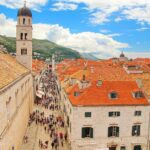
Stradun, also called Placa, is the city’s famous main promenade, and you’ll walk it as part of the tour. Your guide explains it as a gathering place where public feasts and processions took place—and also the main business street.
Here’s the practical value: Stradun is also your orientation tool. It’s the widest street and, in a simple way, it divides Old Town into the northern and southern halves. When you understand that division, the rest of the city stops feeling like random turns and starts feeling like a readable map.
This is also where the tour brings modern history into the picture. You’ll get a guided look at the demise of the Ragusa Republic, then the later chapters under Yugoslavia and the Homeland War in the 1990s. It’s handled in a way that connects back to what you’re standing beside, not just a lecture from a distance.
Holy Annunciation and the Mix of Faiths in the Side Streets
After Stradun, you step off onto narrower inner streets walking toward the Port. You’ll stop by the Orthodox Christian Church connected to the Church of the Holy Annunciation area and hear how other religious communities—Orthodox Christian, Jewish, and Muslim—shaped Dubrovnik’s history.
This section is valuable because Dubrovnik is often marketed as one heritage story, but it’s clearly been shaped by different communities over time. When you understand that, you can appreciate why certain buildings, symbols, and traditions appear where they do.
If you’re traveling with teens or anyone who gets bored by long history, this part can work. It turns the city into a living map of influences.
You can also read our reviews of more historical tours in Dubrovnik


Gundulic Square Market Energy and Ivan Gundulic’s Monument
At Gundulic square, you’ll pass the Monument of Poet Ivan Gundulic. The tour pairs the monument with the nearby green market area, so you get a sense of everyday life happening beside the big landmarks.
This stop is a good breather. You’re not stuck at a single point staring up at stone. Instead, you get a quick cultural snapshot—what locals might buy, what the market looks like, and how the Old Town has stayed practical even while it’s world-famous.
It’s a smart reminder: Dubrovnik isn’t only for sightseeing. People still live with the same streets you’re walking.
Rector’s Palace and Cathedral Legends: The Power Center Meets the Myth
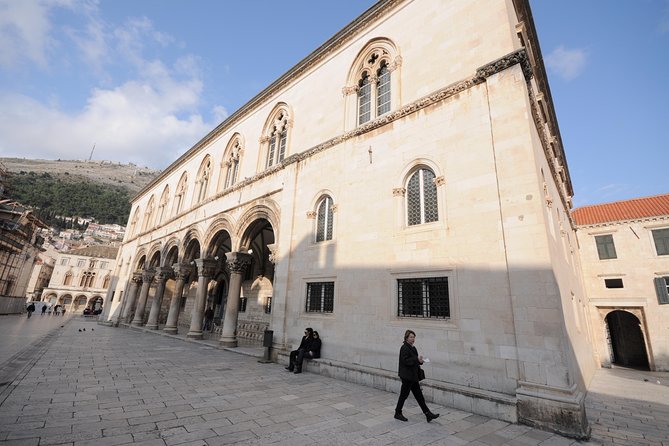
Next comes the Rector’s Palace, and the guide makes the building feel like a government machine. You’ll learn it served as the seat of the Rector of the Republic of Ragusa between the 14th century and 1808. It also housed the Minor Council and state administration, plus places like an armoury, powder magazine, watch house, and a prison.
That list matters because it explains the architecture. You stop seeing it as just a grand facade and start recognizing it as the building where decisions were made and consequences were stored.
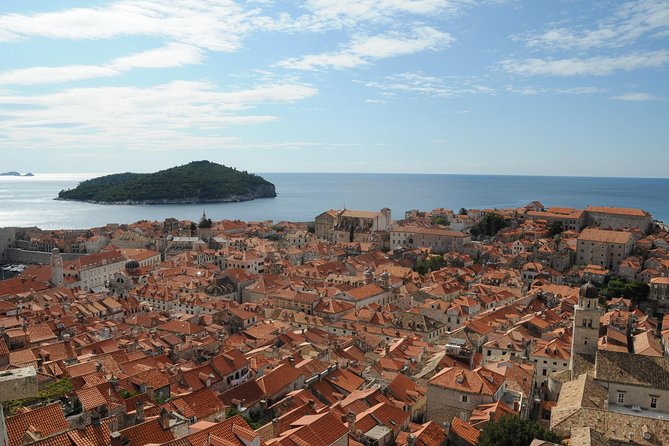
Then you reach the Cathedral of the Assumption of the Virgin Mary. There’s a famous legend here your guide shares: Richard the Lionheart returning from the Crusades in 1192, shipwrecked in a storm, and casting aground on Lokrum Island in front of Dubrovnik. Even if you treat legends as legends, the point is that Dubrovnik has always collected dramatic stories tied to the sea.
City Harbor: Ships, Quarantine, and Fortresses You Can Actually Find
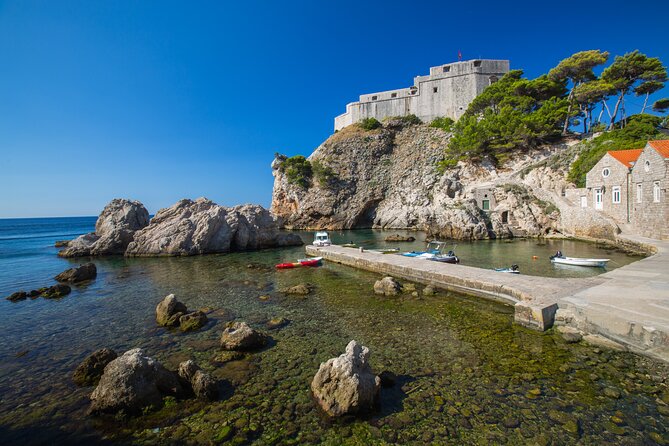
The walk to the harbor shifts the focus to maritime life. Dubrovnik’s ships were renowned across the Mediterranean, and galleons from the Republic could be found in navies far beyond. Your guide explains how ships were built and loaded in the legendary Arsenal (not just a name, but part of the city’s working history).
Then you’ll hear stories tied to the Old Port area, including the famous Quarantine and nearby fortresses of St. Luke and St. John. The practical value here is clear: once you understand quarantine and fortifications, you’ll better appreciate why coastal cities were obsessed with controlling who—and what—came ashore.
This is also a good place to slow down mentally. Dubrovnik’s harbor views are gorgeous, but without context you can miss what the coastline was protecting.
Orlando Column, Luza Square, and Finishing Under the Bell Tower
After leaving the port, you walk to the eastern end of Stradun under the City Bell Tower, reaching Luza square. This section is packed with memorable stops and quick stories that connect.
You’ll hear about the church dedicated to the patron St. Blaise and the legend of the knight Orlando and his column. The guide also points out Sponza Palace, the Small Onofrio’s Fountain, and the high bell tower.
If you want a simple souvenir of this tour, it’s this. By the time you finish here, the Old Town landmarks stop being isolated. They start forming a chain: trade routes, government power, religious authority, and public ceremonies all visible in the same few blocks.
You end back at the meeting point, so you’re not left stranded across town after your 90-minute intro.
Price, timing, and why this costs about $24.19 well spent
The price is $24.19 per person for about 1 hour 30 minutes, with local guide and all taxes, fees, and handling charges included. Admission at the stops is listed as free in the tour details, which helps you avoid surprise add-ons for basic viewing.
For Dubrovnik, where many experiences add up quickly, this is a low-cost way to get orientation plus meaning. You’re paying for a guided thread through the city, not for buildings you could technically walk past on your own.
It’s also popular: the tour is commonly booked around 37 days in advance. That’s a clue to plan early if you have fixed travel dates, especially in the months when Old Town feels crowded.
Group size matters here too. With a maximum of 30 travelers, the pace tends to stay manageable. You’ll still get the chance to hear the guide clearly without feeling like you’re in a human traffic jam.
Practical tips before you go (so you enjoy the walk more)
- Wear shoes you trust. Dubrovnik has plenty of stone steps and uneven old surfaces.
- Start your day with the tour if possible. It helps you pick the right places afterward without wandering in circles.
- Bring water. Even if the route feels short on paper, it adds up in warm weather.
- Expect narrow lanes and busy sight lines at key points. If you’re sensitive to crowds, pick a departure time that avoids peak crush.
Weather is also a factor. This experience requires good weather, and if it’s canceled because of poor conditions, you’ll be offered a different date or a full refund.
Should you book Dubrovnik’s Old Town History Walking Tour?
If it’s your first time in Dubrovnik, I think you should book this. It’s one of the cleanest ways to get the big-picture story of Ragusa to modern Dubrovnik while you’re standing in the exact places where those stories played out.
Choose it if you want a simple plan for a tight schedule, especially since it hits major highlights like Stradun, Franciscan Monastery, Rector’s Palace, the Cathedral area, the harbor, and the Luza square monuments in one smooth walk. At around $24.19 for a guided, English-language overview with a group cap of 30, it offers strong value for the amount of context you’ll carry into the rest of your trip.
If you have mobility concerns, you’ll want to think carefully. The Old Town walk includes steps and crowded areas, and one review specifically flagged that less able visitors may find it harder. If that’s you, consider whether you can comfortably manage uneven stone and stair climbs for roughly 90 minutes.
If you fall somewhere in the middle—curious, short on time, and ready to understand what you’re looking at—this is a smart place to start.
FAQ
How long is the Dubrovnik Old Town History Walking Tour?
It runs for about 1 hour 30 minutes.
Where do we meet for the tour?
You meet at Onofrio’s Large Fountain, near the Hard Rock Cafe, by the red umbrella.
Is the tour offered in English?
Yes, the tour is offered in English.
What’s included in the price?
The local guide and all taxes, fees, and handling charges are included.
Do I need to pay admission for the stops?
The tour details show the stops as admission ticket free.
What if the weather is poor?
This experience requires good weather. If it’s canceled due to poor weather, you’ll be offered a different date or a full refund.